Pain Profile: Cervical Radiculopathy
Ever felt a sharp, shooting pain zip down your arm like an electric shock, or noticed a stubborn patch of numbness in your fingers that just won't budge? While it may feel like an arm problem, the true culprit is often sitting right up in your neck.
Whether you spend your days logging hours at a desk, training hard in the gym, or managing a busy lifestyle, neck and arm symptoms can completely derail your day.
In this edition of our Pain Profile, we break down Cervical Radiculopathy—more commonly known as a pinched nerve in the neck.
What is Cervical Radiculopathy?
Your spinal cord serves as the main highway for messages travelling between your brain and the rest of your body. In your neck (the cervical spine), individual nerve roots branch off this main highway to supply sensation and strength to your shoulders, arms, hands, and fingers.
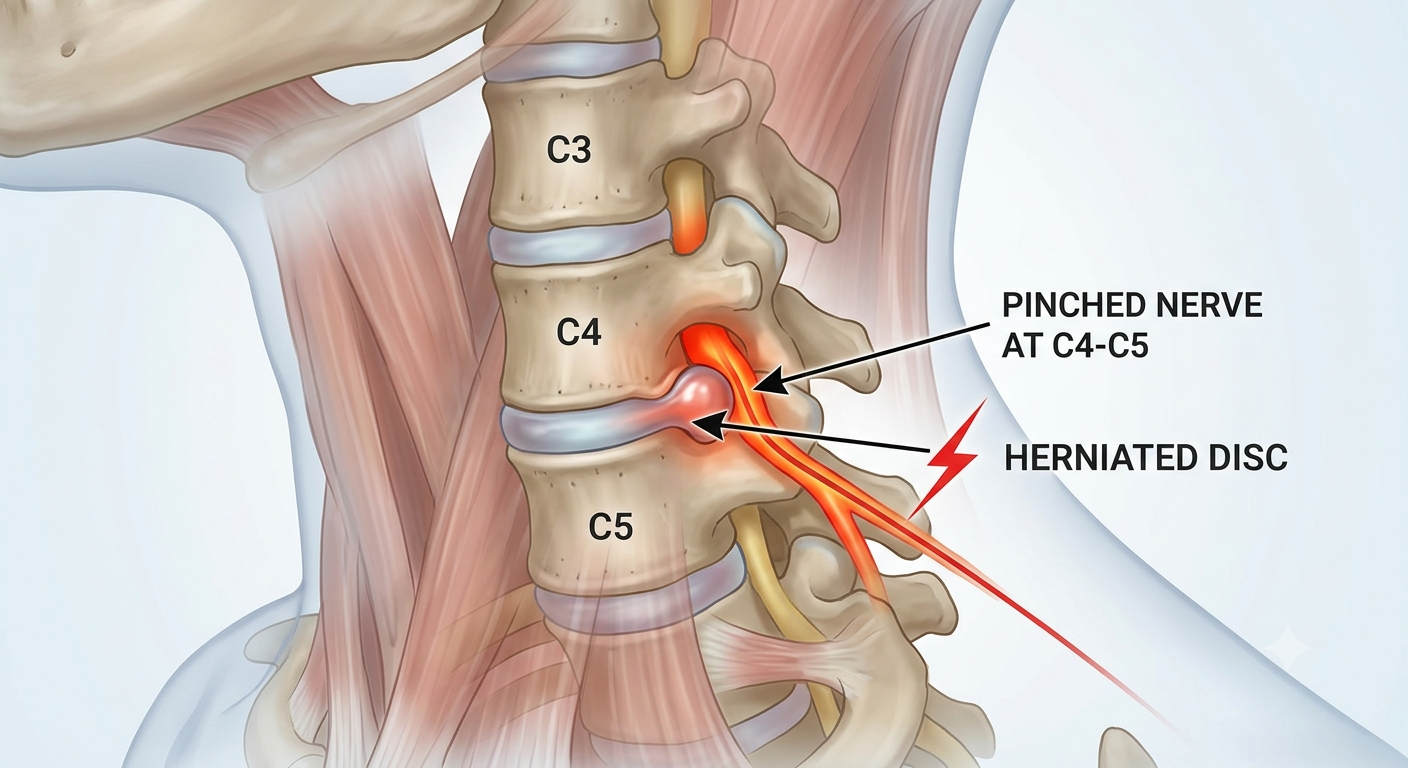
Image generated using Google Gemini AI
Cervical radiculopathy occurs when one of these nerve roots becomes compressed or irritated right where it exits the spine—often due to a bulging disc or natural, age-related structural changes like bone spurs.
Understanding Your Symptoms: The Dermatome Map
Because these nerves travel all the way down to your fingertips, the symptoms can show up anywhere along that pathway. Where you feel the symptoms tells us a lot about exactly which nerve root in your neck is unhappy. This specific mapping of skin sensation is called a dermatome.
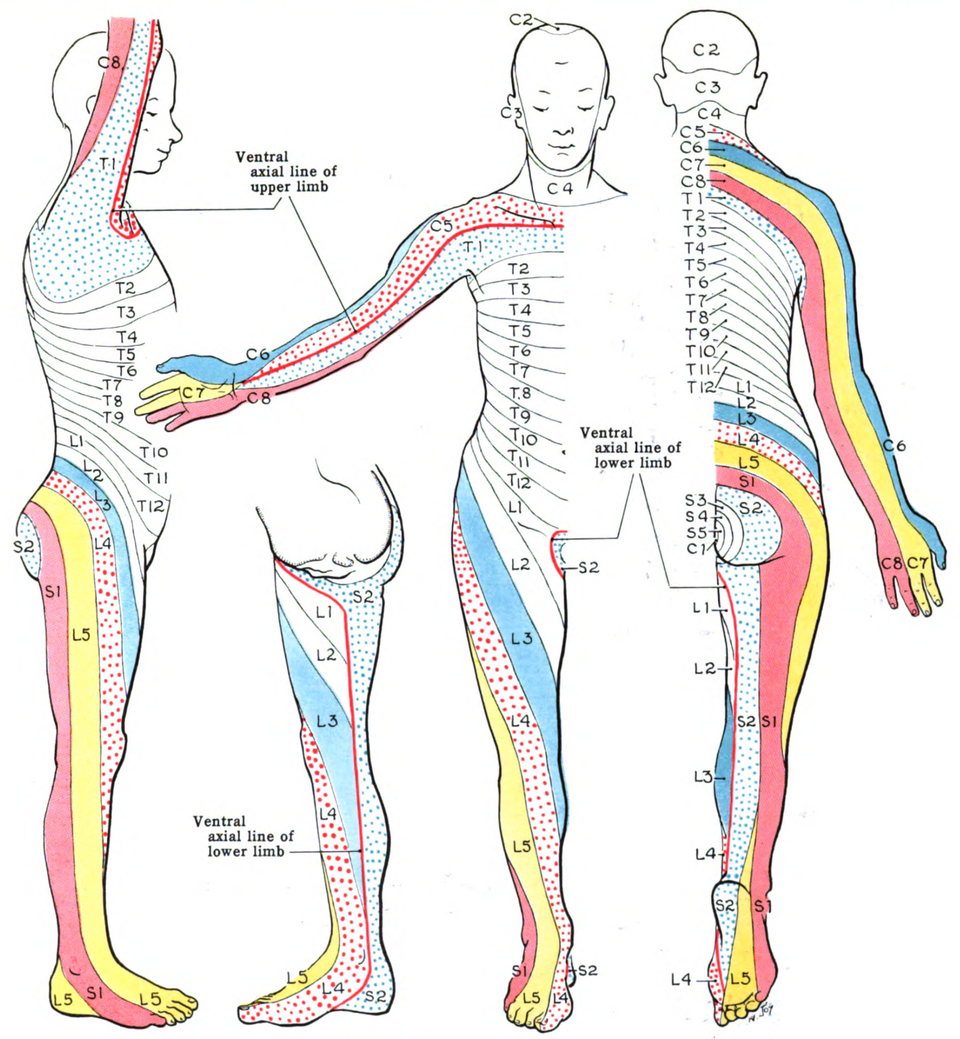
The classic Keegan and Garrett dermatome map. Source: TeachMeAnatomy
Depending on the nerve involved, you might experience:
Radiating Pain: A sharp, burning, or electric-shock sensation travelling down the shoulder, arm, forearm, or hand.
Sensory Changes: "Pins and needles", tingling, or complete numbness in specific parts of the hand or fingers (following the dermatome lines).
Weakness: Difficulty lifting your arm, gripping objects, or performing fine motor tasks like buttoning a shirt.
Neck Distraction: Interestingly, some people feel intense arm pain with very little actual neck pain!
Do I Need a Scan?
It is incredibly common to wonder if you need an MRI or X-ray to figure out what is going on. While imaging can be helpful to confirm exactly which structure is irritating the nerve, the reality is that imaging rarely changes how we treat it.
Whether a scan shows a mild disc bulge or a tiny bone spur, the evidence-backed rehabilitation pathway remains essentially the same. We treat the person, not the scan, focusing entirely on reducing your pain and restoring your movement.
How We Manage It: Phase 1 Care & Beyond
The vast majority of pinched nerves respond brilliantly to conservative, non-surgical management. We break our care down into clear stages, focusing first on calming the system down before building it back up.
Phase 1 Care (Symptom Easing): This is where hands-on therapy comes in. In the early stages of a pinched nerve, the surrounding muscles often lock up in a protective spasm, which can actually increase the pressure on the nerve. Targeted soft tissue work, manual therapy, and gentle mobilisation are key components here—helping to desensitise the area, settle muscle guarding, and give you much-needed pain relief.
Nerve Gliding: Specific, gentle movements designed to help the nerve slide smoothly through its anatomical pathways, reducing localised friction and irritability.
Load Modification: Pinpointing and adjusting the daily habits, desk setups, or training movements that are actively irritating the nerve, allowing the tissue a chance to heal.
Progressive Strengthening: Once Phase 1 is complete and the pain settles, we transition to building up the deep supporting muscles of the neck, upper back, and shoulder blade to protect the spine long-term.
Let's Get It Sorted
You don't have to simply wait out stubborn arm pain or distracting pins and needles. If you're ready to take the pressure off your neck and get back to moving freely, click below to book an assessment with our team.
References
Blanpied, P. R., Gross, A. R., Jull, G. A., Elliott, J. M., Cleland, J. A., Delitto, A., ... & Torburn, L. (2017). Neck pain: Clinical practice guidelines linked to the international classification of functioning, disability and health from the orthopaedic section of the American Physical Therapy Association. Journal of Orthopaedic & Sports Physical Therapy, 47(7), A1-A83. https://doi.org/10.2519/jospt.2017.0302
Borrella-Andrés, S., Marqués-García, I., Lucha-López, M. O., Fanlo-Mazas, P., Hernández-Secorún, M., Pérez-Bellmunt, A., ... & Hidalgo-García, C. (2021). Manual therapy as a management of cervical radiculopathy: A systematic review. BioMed Research International, 2021, 1-11. https://doi.org/10.1155/2021/9936981 Cited by: 83
Rissardo, J. P., & Fornari Caprara, A. L. (2023). Management of cervical radiculopathy: Current systematic reviews. Indian Journal of Health Sciences and Biomedical Research (KLEU), 16(3), 441-442. https://doi.org/10.4103/kleuhsj.kleuhsj_368_23 Cited by: 2
The Royal Australian College of General Practitioners. (2023). Clinical guidance for MRI referral: Cervical radiculopathy. RACGP.